If you have been doing SEO for a while, you already know the drill — find keywords, write content, build links, wait. That system worked beautifully for years. But something quietly shifted, and 2026 is the year most website owners are finally feeling it.
People are no longer just searching. They are asking. And the platforms answering them are not always sending traffic back to your site.
Welcome to the era of Answer Engine Optimisation — AEO for short.
What Exactly Is AEO?
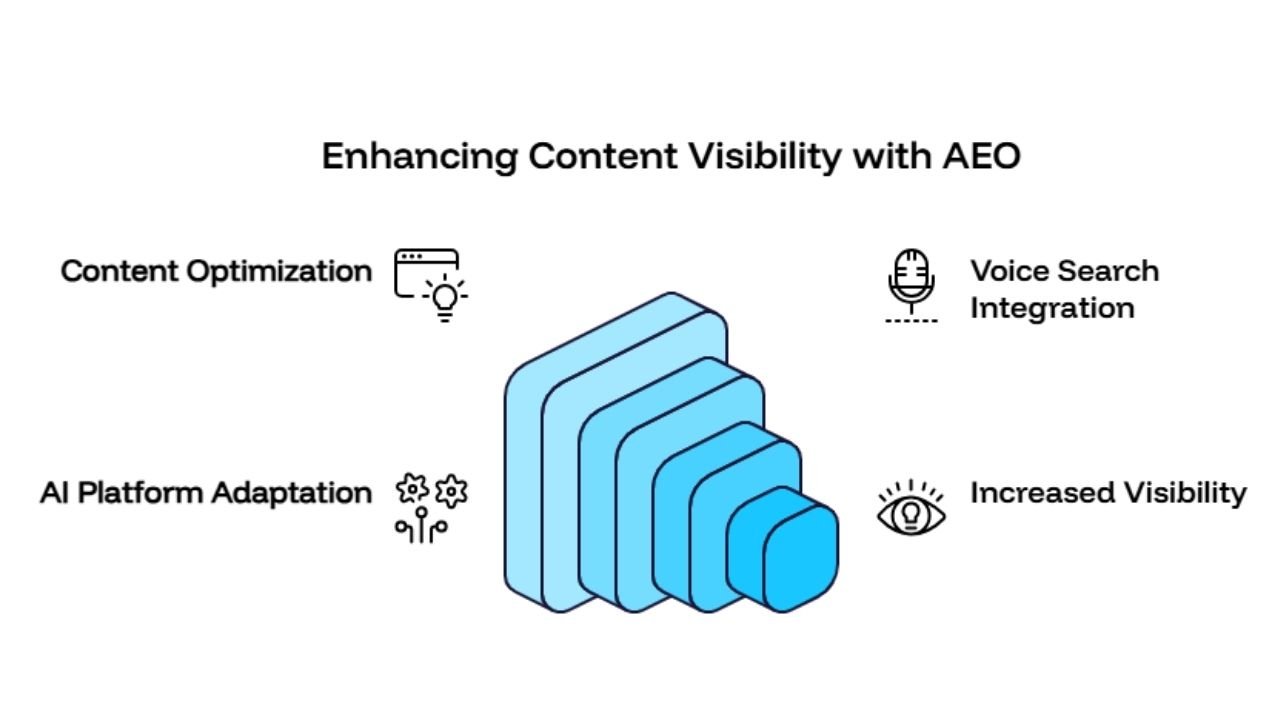
AEO is the practice of structuring your content so that AI-powered answer engines — like Google’s AI Overviews, ChatGPT, Perplexity, Microsoft Copilot, and similar tools — pull from your website when generating responses to user questions.
Traditional SEO gets your page to rank. AEO gets your content to become the answer.
When someone types “how do I fix a leaking faucet” into Google today, there is a good chance the very top of the page shows an AI-generated summary that answers the question directly. No click needed. The user got what they wanted, and the site that contributed that information may have gotten zero visits from it.
That is both the challenge and the opportunity of AEO.
How Is AEO Different from Traditional SEO?
Traditional SEO and AEO share a common goal — visibility. But how they get there is quite different.
With traditional SEO, you are optimising for a ranking position. You want to show up on page one, ideally in the top three results, and you rely on the user clicking your link.
With AEO, you are optimising for being cited. You want your content to be so clear, so authoritative, and so well-structured that an AI engine trusts it enough to quote or paraphrase it when answering a query.
Think of it this way. Old SEO was about getting a seat at the table. AEO is about being the person everyone at the table is quoting.
Why Is AEO a Big Deal Right Now?
A few things converged in 2025 and early 2026 that made AEO impossible to ignore.
Google’s AI Overviews went mainstream. After a rocky rollout, Google’s AI-generated search summaries became a permanent fixture at the top of the results page for a huge range of queries. Informational searches — the kind that used to drive enormous organic traffic — are now often answered without a single click.
ChatGPT and Perplexity became legitimate discovery tools. A growing number of people now start their research directly in an AI chatbot rather than a search engine. If your brand or website is not being cited in those conversations, you are invisible to that audience.
Voice search grew up. Smart speakers and voice assistants are almost exclusively answer engines. They do not give you ten blue links — they give you one answer. If you are not that answer, you do not exist.
What Does Google Actually Look for When Choosing Content for AI Answers?
This is where it gets practical. Google and other AI systems are not picking content randomly. They are looking for signals that a piece of content is genuinely trustworthy and genuinely useful.
Clarity over cleverness. Content that directly answers a question in plain language almost always wins over content that dances around the topic for three paragraphs before getting to the point. If someone asks “what is AEO,” your content should answer that in the first or second paragraph, not in the conclusion.
Demonstrated expertise. Google’s E-E-A-T framework — Experience, Expertise, Authoritativeness, and Trustworthiness — matters more than ever in the AI era. Content that shows real-world experience, written by someone with credentials in the field, gets weighted more heavily.
Structured information. FAQ sections, clear headings, numbered steps, and concise definitions all make it easier for AI systems to extract and use your content. If your page is one long unbroken wall of text, it is much harder to parse.
Being cited elsewhere. When other credible websites link to your content or reference your brand, it signals to AI systems that you are a reliable source. This is where traditional link-building still plays a role — just in a new context.
The Trust Factor: Why AEO and Brand Authority Are Inseparable
Here is something a lot of people miss about AEO. It is not just a content strategy — it is a trust strategy.
AI engines are not just looking at your content. They are looking at your reputation. Are people talking about your brand? Are other authoritative sites referencing you? Do your social profiles, your Google Business Profile, and your website all tell a consistent story about who you are and what you know?
If the answer is yes, you become a go-to source. If the answer is no, you get skipped over even if your content is technically well-written.
This is why businesses that invest in building genuine authority — through consistent publishing, through community presence, through earned media — tend to benefit the most from AEO.
A Real Example of AEO in Action
Say you run a physiotherapy clinic and you publish a well-researched article titled “Why does my lower back hurt after sitting all day?” The article directly answers the question, explains common causes in plain terms, offers clear advice, and links to a few reputable medical references.
When someone asks that question to Google or Perplexity, your article becomes a candidate for the AI summary. You might not get a click. But your clinic name appears in the answer. That is brand exposure. And when the same user later decides they need a physiotherapist, guess whose name they already recognise.
That is the long game of AEO.
How to Start Optimising for Answer Engines
You do not need to tear down your existing content strategy. AEO builds on top of good SEO, not in place of it. A few practical places to start:
Identify the questions your audience actually asks. Tools like Google’s “People Also Ask” section, Reddit threads, and forum discussions in your niche are gold mines for this. Real questions, asked in natural language, are exactly what AI engines are fielding every day.
Write direct answers near the top of your content. Do not make the reader scroll to find what they came for. State the answer clearly, then go deeper.
Use FAQ sections. These are one of the most reliable ways to get cited in AI-generated answers because they match the format of how questions are asked.
Build your author and brand credibility. Create detailed author bios, maintain a consistent publishing schedule, get featured on credible industry platforms, and keep your Google Business Profile updated.
Mark up your content with structured data. Schema markup helps AI systems understand the context and type of your content. FAQ schema, HowTo schema, and Article schema are particularly useful.
The Bottom Line
AEO is not a replacement for SEO. It is the next layer on top of it. In 2026, the businesses and websites that understand this will capture a kind of visibility that goes beyond page rankings — they will become trusted sources that AI engines actively cite.
That is a genuinely powerful position to be in. And it is available to anyone willing to create content that actually helps people, structured in a way that machines can understand and trust.
Start there, and the rest tends to follow.
Published by GetAIRanks.com — Helping businesses get found in the age of AI search.