The landscape of digital search is shifting rapidly, and Australian businesses can no longer afford to rely solely on traditional strategies. The debate around GEO vs SEO (Generative Engine Optimization) is no longer a niche conversation; it is now central to how brands win or lose visibility online. As AI-powered tools like ChatGPT, Google Gemini, and Perplexity AI take over more search interactions, understanding the difference between Generative Engine Optimization and traditional SEO has become essential for every marketer and business owner in Australia.
This guide breaks down both approaches, explains how they work together, and shows you exactly what steps you can take to ensure your business appears in both traditional search results and AI-generated recommendations.
What Is Traditional SEO and How Does It Work?
Traditional SEO (Search Engine Optimization) is the practice of optimizing your website so it ranks higher on search engines like Google and Bing. It involves a combination of on-page content, technical website performance, and off-page authority signals such as backlinks.
Core elements of traditional SEO include:
- Keyword research and strategic placement
- On-page optimization: title tags, meta descriptions, headers
- Technical SEO: page speed, mobile-friendliness, crawlability
- Link building and domain authority
- Local SEO for location-based searches
- Content quality and topical authority
In Australia, traditional SEO remains the backbone of organic digital marketing. According to Semrush’s State of Search report, organic search continues to drive the majority of website traffic globally, making SEO a non-negotiable investment for businesses of all sizes.
What Is Generative Engine Optimization (GEO)?
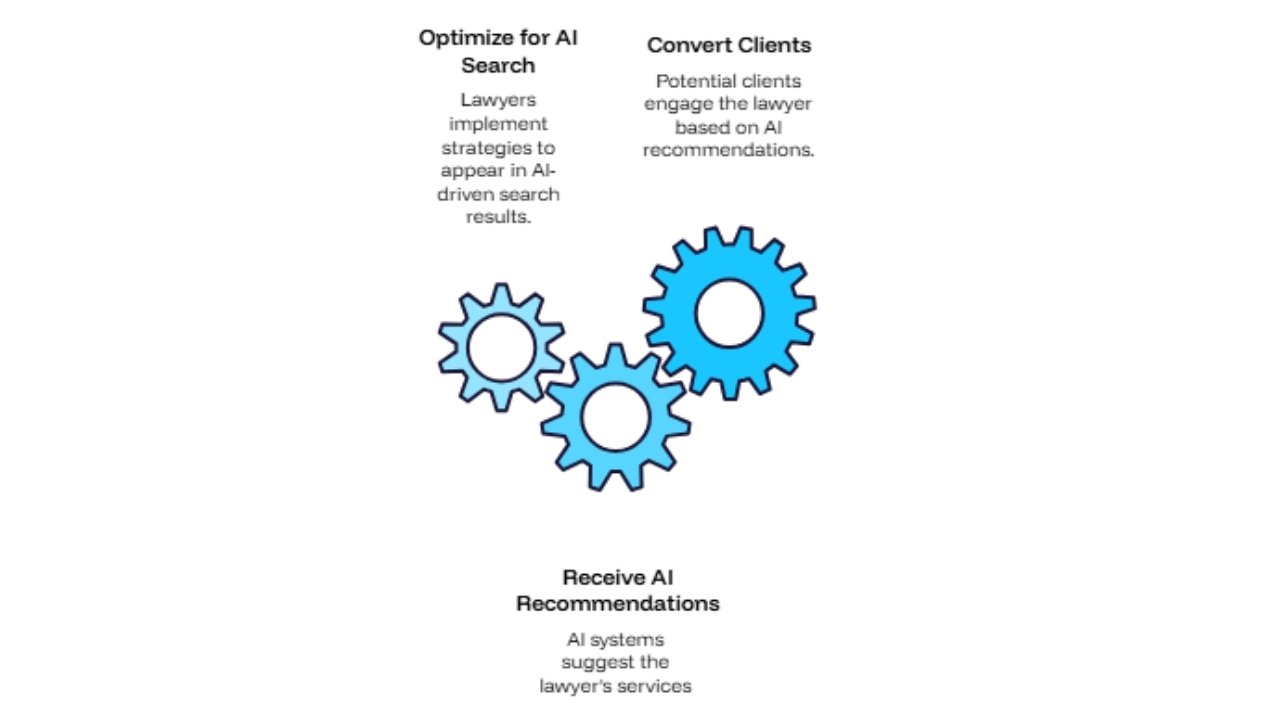
Generative Engine Optimization (GEO) is the process of optimizing your content, brand presence, and digital authority so that AI-powered tools recommend, cite, or feature your business in their generated responses. When someone asks ChatGPT, “What is the best accounting software in Australia?” or asks Google Gemini for a service recommendation, they are using a generative AI engine, and GEO vs SEO is the question that determines which brands appear in those answers.
Unlike traditional SEO, which focuses on ranking pages on a results list, GEO focuses on helping AI models choose your content as a trusted source.The AI does not show ten blue links it gives a single, synthesized response. If your business is not part of that response, you are effectively invisible to that user.
In 2023, researchers from Princeton, Georgia Tech, and IIT Delhi formally introduced the term GEO and showed that generative AI engines are far more likely to surface structured, authoritative, and citation-rich content.You can read more about this foundational research at arXiv — GEO: Generative Engine Optimization.
GEO vs SEO: Understanding the Key Differences
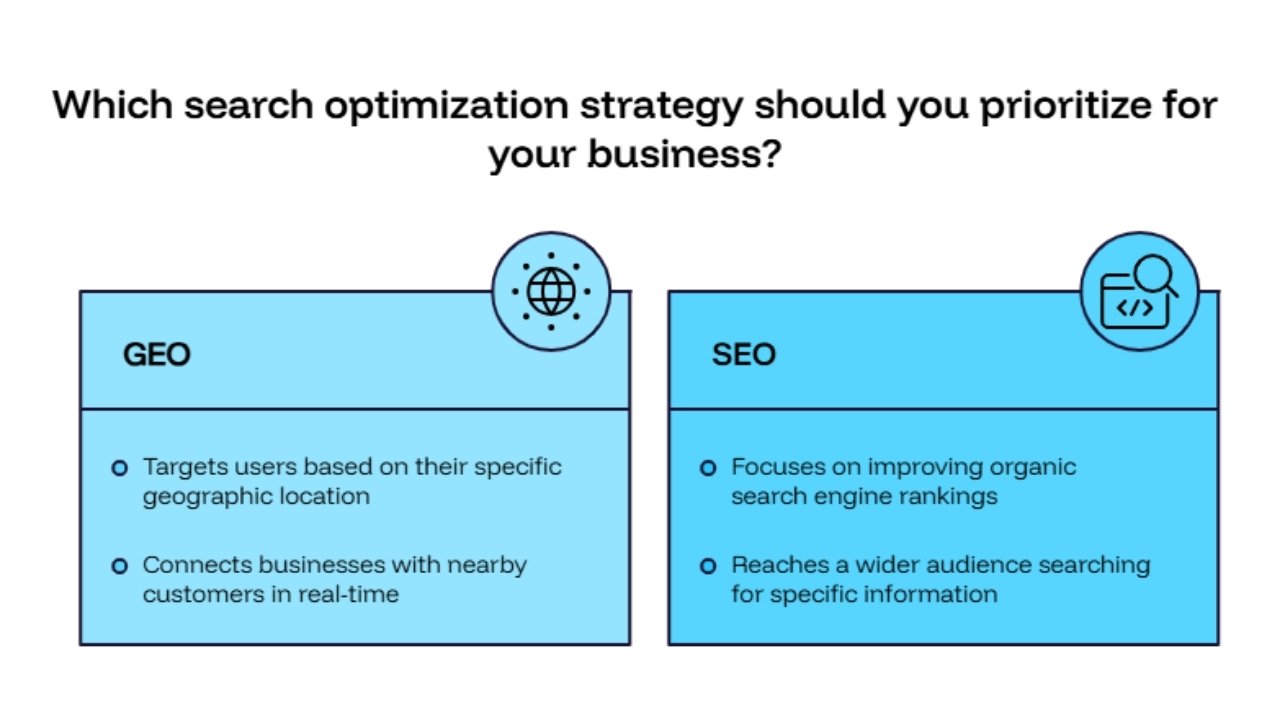
When comparing GEO vs SEO (Generative Engine Optimization), it is important to understand that they serve different engines, answer different intent signals, and require different optimization strategies.
| Factor | Traditional SEO | Generative Engine Optimization (GEO) |
| Target Platform | Google, Bing, Yahoo | ChatGPT, Gemini, Perplexity, Claude |
| Output Format | Ranked list of URLs | Synthesized an AI-generated answer |
| Success Metric | Page ranking position | Being cited or recommended by AI |
| Content Focus | Keywords and backlinks | Authority, structure, and trustworthiness |
| User Interaction | User clicks a link | User reads a generated response |
| Location Signals | Local SEO, Google Business Profile | Consistent NAP data, schema markup |
Understanding this table makes one thing clear: GEO vs SEO is not simply about using different keywords. It requires businesses to adopt a fundamentally different mindset about what ‘being found’ means in the age of AI-driven search.
Why GEO vs SEO Matters for Australian Businesses Right Now
Australia has one of the highest rates of AI tool adoption in the Asia-Pacific region. A growing number of Australian consumers are now using AI assistants for product research, local service discovery, and purchasing decisions. This shift means that the GEO vs SEO (Generative Engine Optimization) question directly impacts your bottom line.
Consider the following data-driven insights:
- Over 40% of Google searches in 2024 resulted in zero clicks, as AI Overviews provided the answer directly on the results page (SparkToro, 2024).
- ChatGPT reached 100 million users faster than any other consumer application in history, and its usage for search-style queries continues to grow rapidly.
- Google’s AI Overviews, powered by generative AI, now appear for a significant portion of commercial and informational queries across Australia.
- Businesses that do not optimize for GEO risk are losing visibility, even if they rank on page one of traditional Google results.
- The Australian Competition and Consumer Commission (ACCC) has noted AI-driven search as a key area of digital market transformation in its 2024 Digital Platform Services Inquiry reports.
To understand how well your brand currently performs in AI-generated responses, consider running an AI visibility analysis to identify gaps and opportunities specific to your industry and location.
How Generative Engine Optimization Works: The Core Principles
Generative Engine Optimization uses principles that differ from traditional SEO.Where SEO focuses on signals like domain authority and keyword density, GEO focuses on the quality and structure of information that AI models can understand, trust, and reproduce accurately.
1. Establish Authoritative, Structured Content
AI models favor content that is clear, accurate, well-cited, and logically structured; using proper headings, data references, and direct answers makes AI far more likely to include it in responses.Think of your content not just as a webpage, but as a reference document that an AI would want to quote.
2. Build Brand Mentions Across Trusted Platforms
GEO requires your brand to be referenced across multiple authoritative sources, industry publications, review platforms, news sites, and directories. The more your business name, products, and services appear in high-quality online contexts, the more an AI model associates your brand with expertise in that area. This is sometimes called “entity building,” and it is central to Generative Engine Optimization.
3. Optimize for Conversational and Long-Tail Queries
People interact with generative AI using natural language questions. Generative Engine Optimization involves creating content that directly answers these questions with depth and precision. Think: “What is the best CRM for small businesses in Melbourne?” rather than just targeting “CRM software Australia” as a flat keyword.
4. Use Schema Markup and Structured Data
Schema markup helps AI crawlers understand what your content is about, who your business is, and what services you provide. For local Australian businesses, implementing LocalBusiness, Product, FAQ, and Review schemas is a foundational GEO tactic that directly improves your chances of appearing in AI-generated answers.
5. Maintain Consistent Entity Information
AI models build a picture of your brand from multiple data points across the web. Ensuring your business name, address, phone number, website, and service descriptions are consistent across Google Business Profile, industry directories, and social platforms strengthens your entity recognition and trustworthiness in AI systems.
GEO vs SEO: Can They Work Together?
GEO vs SEO is not an either-or decision; the two strategies are deeply complementary. In fact, a business that performs well in traditional SEO has many of the foundational elements already in place for strong GEO performance. High-quality content, backlinks from authoritative sites, and solid technical website performance all contribute to success in both disciplines.
Here is how to align both strategies for maximum impact:
- Publish in-depth, expert-level content that satisfies both search engine algorithms and AI training data requirements.
- Build a consistent backlink profile from Australian industry publications, government sources, and reputable news outlets.
- Target featured snippets and Google’s People Also Ask sections, as these formats are frequently used to train and inform AI responses.
- Create a robust Google Business Profile with detailed service descriptions, regular posts, photos, and verified customer reviews.
- Use FAQ sections on key pages. AI tools frequently pull from FAQ-structured content when constructing synthesized answers.
- Publish original research, case studies, or data unique to your business, as AI tools prefer citing sources.
If you want a professional assessment of how your current SEO foundation supports your GEO efforts, an AI ranking audit can provide a detailed evaluation of your strengths and gaps across both traditional and AI-driven search channels.
Practical GEO vs SEO Action Plan for Australian Businesses
Based on the latest research and emerging best practices in Generative Engine Optimization, here is a practical six-step action plan that Australian businesses can begin implementing today.
Audit Your Current AI Visibility
Manually test how your business appears when queried in ChatGPT, Google Gemini, and Perplexity AI. Ask the questions your ideal customers would ask. Note whether your brand is mentioned, cited, or absent entirely. This baseline test is eye-opening for most businesses.
Identify High-Value GEO Keywords and Questions
Research the conversational questions people ask about your services, products, and industry in Australia. Use tools like AnswerThePublic, Google’s People Also Ask, and Reddit forums to surface natural language queries that reflect real user intent.
Create or Update Authoritative Content
For each core topic your business covers, create a comprehensive, well-structured page that addresses the topic thoroughly. Include statistics, references to credible sources, expert perspectives, and clear answers to common questions. Thin content will not perform in a GEO environment.
Implement Technical Schema Markup
Add the FAQ schema, LocalBusiness schema, and Article schema across your key pages. These structured data formats directly assist AI models in understanding and featuring your content. If you are using WordPress, plugins like Yoast SEO or RankMath make schema implementation accessible even without developer resources.
Strengthen Off-Site Brand Presence
Actively pursue mentions, reviews, and citations on Australian platforms such as True Local, Yellow Pages Australia, Clutch, industry associations, and local news outlets. Each mention reinforces your entity’s authority in the data sources that AI systems draw from.
Monitor and Iterate
GEO is an evolving field with no static formula. Regularly test your AI visibility, update your content to reflect new developments in your industry, and track changes in how AI platforms respond to queries about your business category. Explore AI recommendation optimization tools to help monitor your performance systematically over time.
The Future of GEO vs SEO in Australia
According to Google’s Search Central documentation on helpful content, the direction of search is moving firmly toward rewarding expertise, authoritativeness, and trustworthiness, the same three qualities that define strong Generative Engine Optimization.
In Australia, this transition will be shaped by the rapid adoption of AI tools across industries, including healthcare, legal services, financial planning, e-commerce, and real estate. The businesses that begin building their GEO foundations now will carry a significant competitive advantage as the shift accelerates over the next two to three years.
The brands that will dominate AI-driven search in Australia are those that understand GEO vs SEO (Generative Engine Optimization) not as competing disciplines, but as two layers of the same digital authority strategy. Traditional SEO builds the technical and content foundation. Generative Engine Optimization builds the trusted reputation that AI tools use to recommend you over your competitors.
Frequently Asked Questions: GEO vs SEO
1. What is the main difference between GEO and SEO?
Traditional SEO helps your website rank on search engine results pages like Google. Generative Engine Optimization (GEO) helps your brand get recommended, cited, or featured in AI-generated responses from tools like ChatGPT, Gemini, and Perplexity. SEO targets ranked links; GEO targets synthesized answers.
2. Do I need to choose between GEO and SEO?
No. GEO vs SEO is not an either-or decision. The two strategies are complementary, and many elements of strong traditional SEO, such as high-quality content, backlinks, and technical performance, also support GEO. The smartest approach is to build a unified strategy that addresses both simultaneously.
3. How do I know if my business is being recommended by AI tools?
The simplest method is manual testing. Open ChatGPT, Google Gemini, and Perplexity AI, and ask questions that your ideal customers would ask about your products or services in Australia. Check whether your brand is mentioned. For a more systematic approach, use a dedicated AI visibility analysis platform to track your performance over time.
4. Is Generative Engine Optimization relevant for small businesses in Australia?
Absolutely. Local and small businesses in Australia may benefit more from GEO than large national brands, because AI tools frequently provide location-specific recommendations. A well-optimized local business can appear in AI responses for queries like “best electrician in Brisbane” or “top accountant in Perth,” even without a large advertising budget.
5. How long does it take to see results from GEO?
Results from Generative Engine Optimization are not as linear as traditional SEO rankings. Some improvements, such as being cited in AI responses after publishing authoritative content, can happen within weeks. Building a comprehensive and consistent AI presence typically takes three to six months of sustained effort, similar to the realistic timeline for meaningful SEO results.
Taking the Next Step in GEO vs SEO
The question of GEO vs SEO (Generative Engine Optimization) is one that every Australian business owner and marketer needs to address in their digital strategy right now. Traditional SEO remains essential for capturing traffic from Google searches. Generative Engine Optimization actively determines whether AI tools recommend, trust, and cite your brand, transforming how Australians find products and services.
The good news is that GEO and SEO are not in conflict. They are complementary strategies that, when executed together, create a powerful and durable digital presence spanning both traditional and AI-driven search environments.
Businesses that invest in Generative Engine Optimization now by building authoritative content, strengthening brand mentions, implementing structured data, and monitoring AI visibility will be the ones that dominate search results and AI recommendations in the years ahead.
Do not wait until your competitors have already claimed that space.
Take control of your AI visibility today! Visit Get AI Ranks to analyze your AI presence and see how you can optimize your business for both traditional SEO and Generative Engine Optimization.