If you have been paying attention to the SEO conversation over the past couple of years, you have probably heard people throw around the phrase “AI SEO” alongside warnings claiming that traditional SEO is either dying, dead, or becoming irrelevant now that search engines include AI.
Most of that conversation is noise.
Here is the more grounded truth: there is not actually a hard line between AI SEO and traditional SEO. What has happened is that the definition of “doing SEO well” has evolved, and the businesses that understood the underlying purpose of SEO have adapted more easily than those who were following a checklist of tactics.
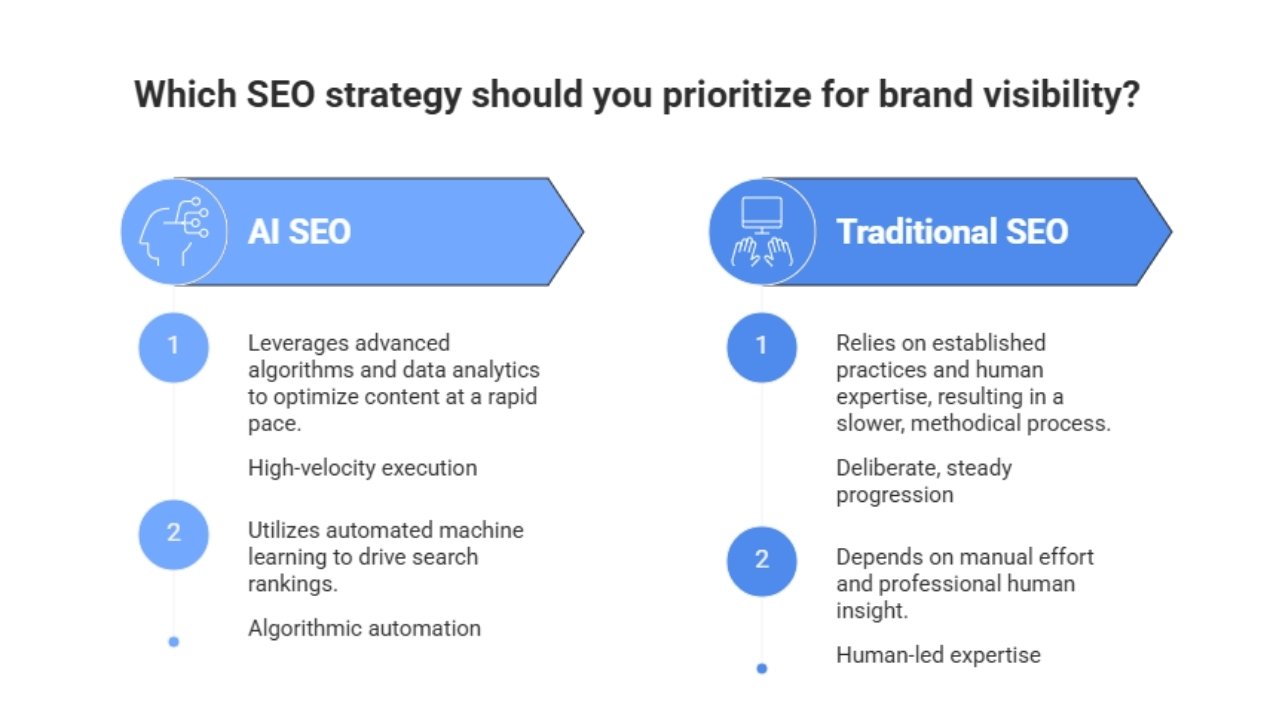
That said, there are real and meaningful differences in approach, emphasis, and outcome between how SEO was practised three to five years ago and how it needs to be practised now. Understanding these differences is genuinely useful, especially when you are trying to decide where to invest your time and attention to grow your brand’s visibility.
Let me walk through this honestly.
What We Mean When We Say “Traditional SEO”
Traditional SEO, as most people practised it, was built around a relatively mechanical model. You identified the keywords your potential customers were searching for, you created pages optimised for those keywords, you built links pointing to those pages, and you waited for rankings to improve.
It worked. For years, this approach reliably produced results. Businesses that executed the model consistently got visibility, and visibility led to traffic, and traffic led to customers.
The problem was not the model. The problem was the way it was often implemented. Because the approach was mechanical, it attracted mechanical thinking. Keywords became a checklist. Content became a vehicle for keywords rather than a resource for people. Link building became a numbers game rather than a reputation-building exercise. And as the tactics became widely known, they became commoditised. Every business in every category started doing the same things, and the signal-to-noise ratio in search results got worse.
Google responded by becoming significantly better at understanding what searchers actually wanted versus what website owners wanted them to see. That process has accelerated dramatically with the integration of AI into search systems.
What “AI SEO” Actually Means in Practice
AI SEO is not a separate discipline. It is not a new set of tools you install or a different platform you optimize for. It is a recognition that the systems evaluating your website and online presence are now significantly more sophisticated, and they reward different things than they did even two years ago.
When people talk about AI SEO, they are typically referring to a few different things:
Optimising for AI-generated answers. Search engines now often answer queries directly with AI-generated summaries that may or may not include links to source websites. To appear as a source within these summaries or to earn recommendations within them, you must structure your content clearly, make it trustworthy, and provide genuinely informative material that AI systems can verify and reference.
Being visible in non-Google AI search environments. Tools like Perplexity, ChatGPT, Copilot, and others are now being used by a meaningful segment of the population to get answers and recommendations. These tools draw on web content and business data, and having a presence that is readable and trustworthy across these environments requires thoughtful content and structured information.
Using AI tools to assist SEO work. Many practitioners now use AI tools to help with content research, drafting, competitive analysis, and technical audits. This is a workflow change, not a fundamental change in what constitutes good SEO.
The outcome of AI SEO, when done well, is that your business appears consistently and authoritatively whenever someone, using any tool, is looking for what you offer.
The Key Differences in Approach
Here is where things get practically useful. The differences between a traditional SEO mindset and what is required now come down to a few key areas.
Content Depth vs Keyword Density
Traditional SEO often focused on keyword density as a quality proxy. How many times does the target keyword appear? Is it in the title, the headings, the first paragraph? These were measurable signals, and measuring them felt like precision.
In 2026, content quality is evaluated by AI systems that can understand what a page is about and whether it actually answers the user’s question. These systems also assess whether the information is comprehensive or superficial and whether it reflects real knowledge or just assembled text.
Keyword presence still matters, but it matters as evidence of topical relevance rather than as a metric to optimise in isolation. A page that answers a question thoroughly will naturally contain the relevant terms because that is what language does when someone actually knows their subject.
The practical implication is that content now needs to be written primarily for the reader, covering the topic with genuine depth, and keyword strategy should inform that process rather than drive it.
Link Quantity vs Genuine Authority
Traditional link building often focused on acquiring as many links as possible from as many websites as possible. Tools emerged to help build links at scale, and the link count of a domain became something to optimise directly.
AI systems have made this approach not just ineffective but potentially harmful. Google’s systems are now quite capable of identifying links that exist primarily to manipulate rankings rather than to provide genuine referral value. The penalty profile for such links has sharpened considerably.
What builds genuine authority in 2026 is being referenced by sources that have their own established credibility. A mention in a respected industry publication, inclusion on a professional association’s recommended supplier list, a reference in a well-read local publication, a link from a complementary business with an established audience, these carry weight precisely because they are hard to manufacture at scale.
This does not mean you need to be featured in major media to rank. It means that the quality and authenticity of the references you earn matters more than the volume.
Technical Compliance vs Full Technical Excellence
Traditional SEO treated technical optimization as a checklist. You ensured your site was crawlable, had proper redirects, avoided duplicate content, and loaded at an acceptable speed. These were meaningful differentiators at the time because many websites had significant technical deficiencies.
Today, technical adequacy is table stakes. Every serious business website either has these basics covered or should. The differentiation now comes from a more holistic technical foundation that includes excellent mobile performance, structured data implementation, Core Web Vitals optimisation, and semantic HTML that helps AI systems understand your page structure and content hierarchy.
The technical bar has risen, but the investment required to meet it has also become more accessible because the tools and knowledge to address these factors are widely available.
Single-Channel vs Multi-Surface Presence
Traditional SEO was largely about ranking in organic search results on Google desktop. This was the primary channel that mattered, and optimising for it took up the majority of attention.
Brand visibility in 2026 requires a multi-surface mindset. Your business needs to be findable and credible across Google Search (organic and local), Google AI Overviews, Google Maps, voice search, AI recommendation tools, and increasingly, across the social search behaviours that have grown particularly among younger demographics.
These surfaces draw on overlapping but distinct sets of signals. A strong website with excellent content helps on most of them. A well-maintained Google Business Profile helps on local and voice-specific surfaces. Review volume and quality helps across all of them. Structured data helps machine-readable surfaces specifically
Which Builds Brand Visibility Faster?
This is the question people actually want answered, so let me address it directly.
Neither approach is inherently faster in isolation. What determines the speed of result is the quality and consistency of execution.
Where a more modern, AI-aware SEO approach tends to outpace a purely traditional approach is in the compound benefits of building genuine trust signals. When you are creating content that genuinely helps people, earning authentic reviews, building real local authority, and maintaining a consistent and structured online presence, you are producing results that reinforce each other.
A keyword-targeted page with manufactured links might achieve a ranking quickly. But that ranking is fragile. It does not generate reviews or community mentions. It does not improve with time or earn new references and sits at its ranking until the algorithm shifts or a better competitor arrives.
Versus a business that has invested in genuine content, an active review profile, structured local presence, and community mentions. That business may take six to twelve months to see meaningful momentum. But at that point, its visibility is resilient, self-reinforcing, and increasingly difficult for competitors to displace without making the same quality of investment.
For local businesses in particular, the visibility that comes from this genuine-authority approach also tends to convert better. When an AI tool recommends your business as the trusted local option for a query, the person who discovers you arrives with more confidence than someone who simply clicks the third result in a generic list.
What the Data Tells Us About Visibility Growth
There is a pattern that appears consistently when comparing businesses that have invested in AI-era SEO practices versus those maintaining older approaches.
Businesses with comprehensive Google Business Profiles, consistent citation information, regular review activity, and content that reflects genuine local expertise tend to maintain stronger local pack visibility over time. When Google updates its algorithms, which happens regularly, these businesses tend to be insulated from major drops.
Conversely, businesses that relied heavily on link schemes, thin content, or purely technical optimisation tend to experience more volatility. An update that better identifies low-quality links or assesses content quality more rigorously hits these sites disproportionately.
The question of “which is faster” also depends on the competitive landscape of your specific market and location. In less competitive local markets, even a modest investment in quality local SEO practices can produce visible results within a few months. In highly competitive markets, the investment required to see meaningful movement is greater, but the durability of that visibility once achieved is also greater.
Where AI Tools Fit Into This Picture
One area where “AI SEO” has a genuinely distinct meaning is the use of AI tools to do SEO work more efficiently. This is worth addressing separately because it is sometimes conflated with the broader strategic question.
AI writing and research tools can help a small business owner create content more efficiently. They can help identify questions your audience is asking, structure responses to those questions, and draft content that can then be refined with genuine expertise and local knowledge.
The important distinction is that AI-generated content used without human expertise and local knowledge tends to produce content that is generic and interchangeable. Every business using AI to write content without a genuine editorial layer ends up with similar-sounding pages that lack the specific, experience-based knowledge that differentiates them.
The businesses getting the most from AI writing tools are using them as a starting point and drafting layer, then adding the specific examples, local context, genuine expertise, and authentic voice that makes the content actually useful and distinct.
Used this way, AI tools can meaningfully accelerate content production without sacrificing quality. Used as a replacement for genuine knowledge and expertise, they tend to produce content that underperforms because AI systems evaluating that content are increasingly capable of detecting when content is thin despite appearing comprehensive.
A Practical Way to Think About It
Rather than framing this as AI SEO versus traditional SEO, a more useful mental model is to think in terms of what you are actually building.
Traditional SEO, at its worst, was building rankings. Rankings are an outcome metric, and optimising directly for an outcome metric without caring about the underlying quality often produces fragile results.
What you should be building, and what the best SEO practitioners have always actually been building, is a trustworthy, findable, and genuinely useful business presence online. The tactics and emphases required to do that have evolved as search systems have evolved. But the underlying goal has not changed.
In 2026, building that presence means:
Creating content that your customers would find genuinely helpful, written with real knowledge and local relevance. Maintaining an accurate, complete, and active local presence across the platforms where your customers look for you. Earning trust signals from real customers through reviews and community references. Ensuring your website is technically accessible, fast, and structured in a way that both humans and machines can understand clearly.
A business that does all of this consistently will be more visible, grow its visibility faster over a sustained period, and maintain that visibility more reliably than a business focused on ranking tactics alone.
For Australian Local Businesses Specifically
For businesses operating in Australian markets, the distinction between these approaches is particularly relevant because local search in Australia is often not as saturated as comparable markets in the US or UK.
This means the competitive barrier to genuine local authority is often lower than it appears. A local business that invests meaningfully in quality content, profile management, and review generation over twelve months will often see significantly stronger visibility than competitors who are doing the minimum.
The window for this advantage is not unlimited. As more Australian businesses understand what is required to compete in AI-era search, the bar will rise. But right now, there is a genuine first-mover advantage available to businesses willing to invest in the foundational work.
The Bottom Line
AI SEO versus traditional SEO is ultimately a false choice when you understand what each term actually refers to.
If traditional SEO meant: keyword research, content creation, technical foundations, and link building all done with genuine quality and a focus on the reader, then traditional SEO and AI SEO are the same thing. The tactics that have always produced durable results are the ones that are winning in 2026.
If traditional SEO meant: mechanical keyword stuffing, link acquisition schemes, and technical tricks designed to game algorithms, then yes, that approach has become significantly less effective and increasingly risky.
The SEO version that builds brand visibility fastest whether you call it traditional or AI-era—relies on genuine quality, consistent execution, and a sincere effort to become the most helpful and trustworthy answer to the questions customers are asking.
That has always been the right approach. The systems evaluating your website in 2026 are just better at recognising it.
getairanks.com helps businesses build search visibility that compounds over time. Explore our resources to learn how this applies to your specific market.